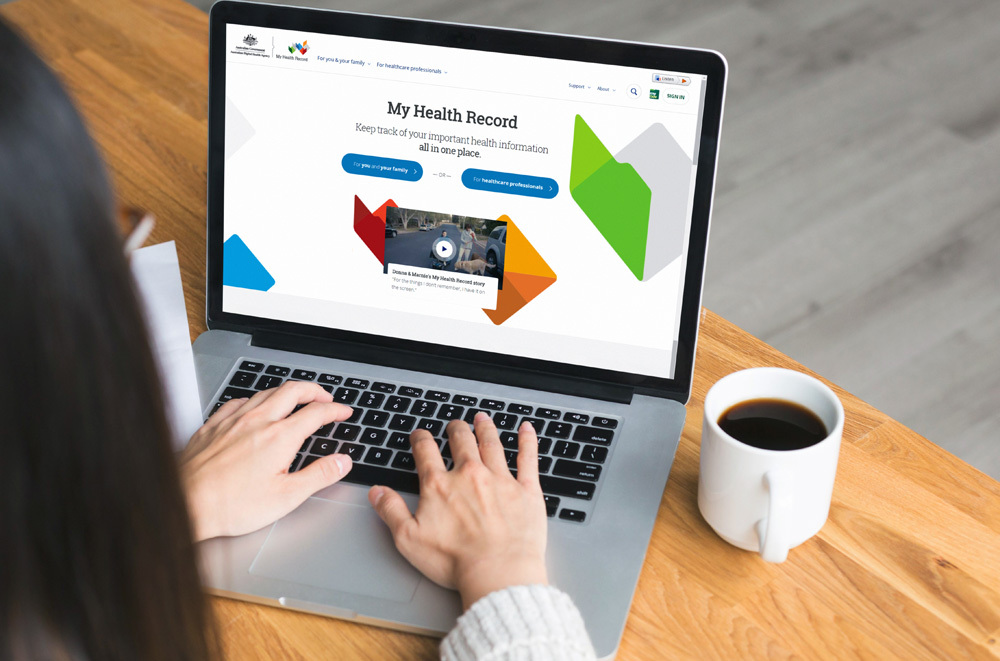
My Health Record (MHR) and NASH certification
A safe and secure place to keep key health information, available to patients and their healthcare providers anytime, including in an emergency.
Benefits to both patients and practices
My Health Records contain key health information like immunisations, pathology and diagnostic imaging reports, prescription and dispensing information, specialist letters, hospital discharge summaries and more, all in one place.
Healthcare provider benefits
- provides immediate access to key health information
- facilitates the validation and verification of clinical information
- avoid adverse medication events, provides access to allergy information
- avoids duplication of tests and diagnostic imaging
- provides immunisation details
- improves continuity of care, informs end of life care
Patient benefits
- prompt access to key health information in an emergency
- secure, convenient access to health information
- safer, faster more efficient care
- less need to remember key aspects of their medical history and medications
- improved management of health information
- informed self-management of health conditions
Privacy and access
Subject to any access controls the patient may have set, a registered healthcare provider organisation’s staff can access My Health Record if:
- they are providing healthcare or undertaking activities to support the provision of healthcare to the patient, and
- the organisation authorises them to do so.
Staff can only author clinical information to upload to My Health Record if:
- they have a Healthcare Provider Identifier – Individual (HPI-I), and
- their registration by a registration authority, or membership of a professional association, is not conditional, suspended, cancelled, or lapsed.
The My Health Records Rule 2016 requires registered healthcare provider organisations to:
- have a My Health Record policy that addresses, among other matters, how staff are trained and authorised to access My Health Record (rule 42), and
- employ reasonable user account management practices and mechanisms (rule 44).
Better and Faster Access
New legislative changes now allow more patients’ health information to be automatically uploaded and made available in My Health Record much sooner. These updates ensure that both the medical practitioner and the patient have timely access to the most up‑to‑date clinical information, supporting safer, more coordinated care. With more health information now being uploaded automatically, patients can access their results sooner, supporting them to be more engaged and proactive in managing their health.
Pathology
- Most pathology reports (like blood and urine tests) are available to view in My Health Record or the 1800MEDICARE app as soon as they are uploaded.
- Some types of reports including anatomical pathology, cytopathology and genetic testing, are viewable after a 5-day delay, reduced from the previous 7-day delay.
Diagnostic imaging
- X-ray reports for limbs (arms and legs) are available to view in My Health Record or the 1800MEDICARE app as soon as they are uploaded by the radiology provider.
- Other X-rays and diagnostic imaging reports (for scans like CT, MRI and PET scans, mammograms and ultrasounds) are viewable after 5 days, reduced from the previous 7-day delay.
Pathology and diagnostic imaging providers will soon be required to upload written reports to My Health Record (share by default). These changes will be introduced progressively throughout 2026, beginning in July, allowing providers time to prepare.
- Patients’ results will be uploaded automatically unless they choose not to have them shared
- All healthcare professionals involved in a patient’s care will be able to view the most recent reports, supporting more coordinated, informed, and safer clinical decision‑making
- Patients benefit from having all their key health information stored securely in one place, making it easier to manage their care, especially when seeing multiple providers or moving between hospitals, imaging services, pathology providers, or clinics.
For more information, please visit the Australian Digital Health Agency website.
e-Requesting (electronic ordering)
Electronic ordering of pathology is available for users of compatible clinical software. Referring GPs can send pathology requests to a patients mobile device via SMS at no cost.
Medical practices wanting to assist their patients and clinicians to access e-requests should check they are using compatible software and that patient files include a valid mobile number.
NASH - National Authentication Service for Health
The National Authentication Service for Health (NASH) is a digital PKI certificate used to authenticate and securely access digital health services. A Nash certificate must be renewed every 2 years to maintain access to these services.
A Nash certificate must be requested and downloaded by the Organisation Maintenance Officer (OMO) by logging into HPOS via PRODA. Once downloaded, the certificate needs to be installed into your clinical software, and any other digital health software that requires a Nash Certificate, such as your secure messaging provider.
NASH Certificates are used to access the following digital health services:
- My Health Record
- Electronic Prescribing
- Secure Messaging
- Healthcare Identifiers (HI) Service
- GP Smart Referrals
-
link
Better and faster access
Resources
-
link
How to implement My Health Record in your pactice
-
link
Assist patients to setup a My Health Record
-
link
My Health Record participant obligations
-
link
My Health Record system security and access policy template
Login to my health record without compliant software
-
link
My Health Record national provider portal login
Digital Health